Bra Size Quiz
Answer a few fit questions and get a recommended size (with sister sizes).

Your complete guide to measuring, sizing, and choosing your best-fitting bra.
Before you can find your perfect bra, you need to know your size. A properly fitted bra will make your clothes look better, feel more comfortable, and give you the support you deserve.
You may be asking—why do I need to watch a video on how to measure my bra size? Well, I think you’ll be surprised at what you’re about to learn.
To begin, wear your best-fitting everyday bra. Start by measuring around your ribcage directly under your bust. This number will determine your band size. Next, measure around the fullest part of your bust to determine your cup size. Keep the tape level but not tight. Subtract your band measurement from your bust measurement; each inch of difference equals one cup size.
Finally, check your fit. Your band should sit level around your body, your straps should stay in place, and your cups should fully contain your breast tissue without gaps or overflow. A properly fitted bra should feel snug but comfortable and make your silhouette look smooth under clothing.
Remember—these are guidelines. Your perfect fit may vary slightly depending on brand and style. If you’re between sizes, try both to see which feels better.
All you need is a soft measuring tape and a non-padded bra. Follow the steps below to determine your band and cup size.
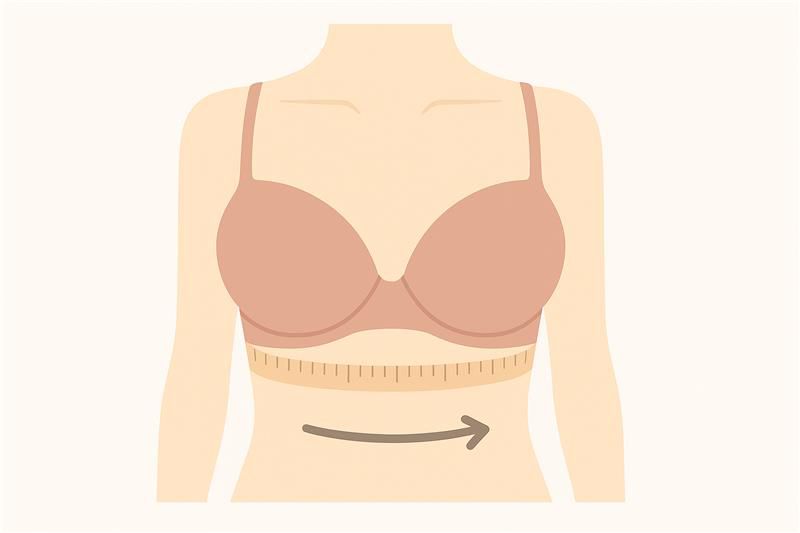
A. Measure your underbust using a tape measure, making sure the tape is parallel with the ground. It should not be loose or binding. Exhale to get the smallest measurement possible.
B. Round your measurement to the nearest whole inch. If the number is even, add 4 inches; if odd, add 5 inches. The result is your band size.
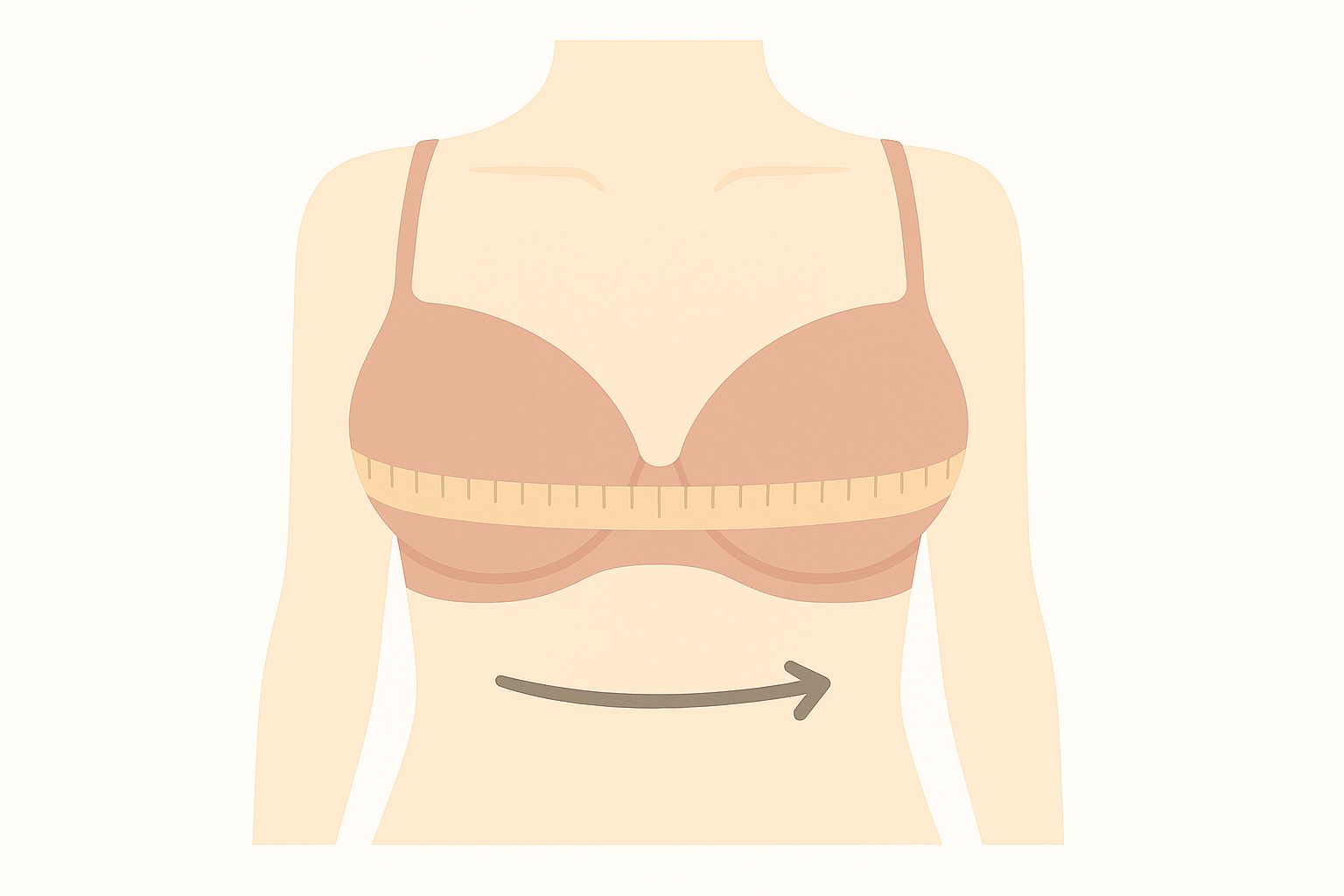
A. While wearing a non-padded bra, stand straight with your arms at your sides and measure around the fullest part of your bust. Keep the tape parallel with the ground and not tight.
B. Subtract your band measurement from this number. Each inch of difference equals one cup size (1 inch = A cup, 2 inches = B cup, 3 inches = C cup, etc.).
Now that you have your band and bust measurements, enter them into the calculator below to see your estimated bra size. Try a few neighboring sizes to confirm the best fit for your unique shape.
Enter your measurements (in inches). We round to the nearest whole inch and match them to our Universal Cup Sizing™ key for a precise starting size.
Women with cup sizes D and larger find manufacturers don't call the same cup size by the same letters. HerRoom's exclusive Universal Cup Sizing™ solves this problem. Know your Universal Cup Size™ and find your correct bra size in any brand, every time.
Note: Although it’s quite easy to find a bra size with these two steps, any bra sizing system using a tape measure will not always give a totally accurate bra size. Several factors can influence your measurements, including:
We suggest watching our ‘Bra Sizing Video’ for tips on accurate measuring.
Quick help
Two fast quizzes to pinpoint your size and the styles that’ll love your shape.
Answer a few fit questions and get a recommended size (with sister sizes).
We match coverage, neckline, and support to styles that fit your life.
Already know your bra size but still struggling to find styles that truly fit your body? Take our Bra Style Quiz — it’ll match you with silhouettes that complement your shape and lifestyle.
Shopping for bras across different brands—or even different countries—can be confusing. A DDD in one brand might be labeled entirely differently in another. For cup sizes above a D, the inconsistency in naming can leave you guessing and lead to the wrong fit.
HerRoom’s exclusive Universal Cup Sizing™ (UCS®) system standardizes bra cup sizes across brands and countries. Since many brands use different letters for the same size above a D cup, UCS® creates a single, consistent size to eliminate confusion. For example, UCS size D3 equals a DDD in the U.S., an E in the UK, and an F in Europe. With UCS®, you’ll know exactly which cup size to choose—no matter the brand—making bra shopping easier and helping ensure the right fit the first time.

Women with bra cup sizes larger than a D have an added layer of difficulty when purchasing bras. Depending on the manufacturer, the same size may be labeled with different letters. Many women search for their usual cup letter, can’t find it, and assume their size doesn’t exist — but it usually does.
There are three general naming conventions for cup sizes beyond D, and they vary by region and brand.
For instance, a triple-D cup might be labeled as an F or E cup depending on the brand. If you’re an H in one manufacturer, that could equal a cup size three steps away in another. It’s no wonder shoppers get frustrated trying to find their size.
At HerRoom, we solved this problem with our trademarked Universal Cup Sizing™ (UCS®) system. It uses a straightforward D-based numbering scale — D1, D2, D3, and so on — to identify your true cup size across all brands and countries.
The UCS number appears in parentheses beside every bra size on HerRoom. This makes it easy to match your fit — any brand, any bra, every time.
Let’s say you wear a 36F in the European brand Chantelle. Right next to that size on HerRoom, you’ll see (D3) — your UCS number. Now, when you shop any other brand, just look for a 36 with the same D3 notation, and you’ll get the correct cup size automatically.
You can even search for your UCS number on HerRoom to see every bra in your size across brands.
You may or may not have heard of this, but the sizes that surround your current bra size are called your sister bra sizes. It’s good to know what they are and how they differ from your correct bra size. This way, when you try on a bra that is not running true to size, you can quickly figure out the bra size that will probably fit you. And, if you feel you need to make a size change due to one or more of the factors that can cause your breast size to change, you again can quickly figure out your new bra size.
Let’s assume your bra size is 36C. Here are your sister bra sizes in your bra size neighborhood.
Horizontal Sister Sizes |
||
| 34D | 36C | 38B |
Going horizontally from your base bra size changes both the band and cup. For example, if your base size is 36C, your horizontal sister sizes are 34D and 38B. This can help when a band feels too tight or too loose but the cup volume needs to stay about the same.
Vertical Sister Sizes |
||
| 36B | 36C | 36D |
Going vertically from your base bra size will give you just a cup size change. If your base size is 36C, a 36B will be a cup size smaller and a 36D will be a cup size larger, while the band stays the same.
Diagonal Sister Sizes |
||
| 34C | 36C | 38C |
Going diagonally combines a band size change with a cup size change. This is helpful when you need a different band and slightly different cup volume to get the best overall fit.
It’s important that you know your measurements before you shop for a new bra. First, determine your bra size by following our quick and easy instructions for DIY Bra Sizing. Then, use the international cup and band size conversion charts below to find your correct bra size.
For more information on how to measure your bra size, watch HerRoom’s How to Measure Your Bra Size Expert Video .
HerRoom’s Fitting Room™ is your key to getting insider information, including fitting and sizing advice, wardrobe guidance, and other tips and tricks that can change the way you think about shopping for lingerie!
Cup Size Chart |
|||||||
| UCS ® | USA | UK | Europe | France | Italy | Australia | Japan |
| AA | AA | AA | AA | AA | AA | A | |
| A | A | A | A | A | A | B | |
| B | B | B | B | B | B | C | |
| C | C | C | C | C | C | D | |
| D1 | D | D | D | D | D | D | E |
| D2 | DD | DD / E | E | E | E | DD | F |
| D3 | DDD | F | F | F | F | F | G |
| D4 | G | FF | G | G | G | FF | H |
| D5 | H | G | H | H | H | G | I |
| D6 | I | GG | J | J | J | GG | J |
| D7 | J | H | K | K | K | H | K |
| D8 | K | HH | L | L | L | HH | L |
| D9 | L | J | M | M | M | J | M |
| D10 | M | JJ | N | N | N | JJ | N |
| D11 | N | K | O | O | O | K | O |
| D12 | O | K | O | O | O | O | P |
“Larger than a D cup? Check out my Universal Cup Sizing™.”
Learn more here.
Band Size Chart |
||||||
| USA | UK | Europe | France | Italy | Australia | Japan |
| 28 | 28 | 60 | 75 | 0 | 6 | 60 |
| 30 | 30 | 65 | 80 | 0 | 8 | 65 |
| 32 | 32 | 70 | 85 | 1 | 10 | 70 |
| 34 | 34 | 75 | 90 | 2 | 12 | 75 |
| 36 | 36 | 80 | 95 | 3 | 14 | 80 |
| 38 | 38 | 85 | 100 | 4 | 16 | 85 |
| 40 | 40 | 90 | 105 | 5 | 18 | 90 |
| 42 | 42 | 95 | 110 | 6 | 20 | 95 |
| 44 | 44 | 100 | 115 | 7 | 22 | 100 |
| 46 | 46 | 105 | 120 | 8 | 24 | 105 |
Sometimes, it's immediately obvious that the bra you have on doesn't fit right. Other times, there are more subtle signs that your bra isn’t doing enough to optimize your shape.
Some of these signs are commonly overlooked, but can make a world of a difference. Even if a bra "feels right" to you, it might not be giving you proper support. It might not enhance your assets as much as it could or should. It might even be the wrong style bra for you altogether ("Know Your Breasts™" Bra Finder).
To help you determine if you have the right fit, use the Bra Fit Checklist below. A well-fitting bra will pass all these checks. Take a few minutes to understand what a bra should look and feel like – then you can assess whether you’re wearing the wrong size or wrong style bra for your breasts.

A well-fitting bra will pass all of the checks below. Use this list while standing in front of a mirror in your best-fitting bra.

If you don't fill out your bra cups – if they’re wrinkling or gapping – you need a smaller cup size (assuming your bra straps have been properly adjusted). If you’re “overflowing” in your cups, or the top of your bra cups are cutting into your breast tissue, try a larger cup size or a style with a fuller cup design. The edges of the cups should also lie flat against your breast. Some women complain the cups look “pointy” (when the bra design is not meant to look this way). This can also be another sign that you are not fully filling out your cups and need to go down a cup size.
If your bra’s center panel is not resting on your sternum, this could be a sign that your cup size is too small. If the underwires are pointing outward and away from your body, this too is a sign that your cup size could be too small. Also, how far apart your breasts are from each other can affect how your center panel rests on your sternum. To address this in more depth, please see our Know Your Breasts™ Bra Finder.
Note: Minimizer bras tend not to rest against the sternum, and this is fine.
The lower edge of your bra band should anchor below your shoulder blades. The lower the back fits, the better the support. Women with spine curvature can have special issues with where the back of their bra will land. Please see our Additional Considerations section for more information about proper bra fitting for women with spine curvature.
Only 10 percent of your bra's support should come from your bra straps. If your straps are working harder than this, you probably need a smaller band size. Women with sloping shoulders need to look for specific bra styles and features to keep their straps up and on their shoulders. Please review our Additional Considerations section for an expanded conversation on bra fitting for narrow and/or sloping shoulders.
The cup fabric should give support as well as a good breast shape. Bras with cups made from stretchy fabric will be comfortable, but your shape and support will be compromised.
Underwires shouldn't poke, protrude or pinch. If your wires bend away from your chest in the center, this usually means your cup size is too small. However, your unique breast placement, shape and size can also impact how bra underwires will fit you. Please see our Classify Your Breasts section for more information about possible causes for underwires not fitting comfortably.
The apex of your breasts should be mid-way between your shoulders and your elbows. Uplifted breasts look more youthful and give a slimming appearance.
The correct bra style will have your breasts pointing forward so that you may freely swing your arms forward and backward without obstruction.
The more you understand the individual parts of a bra, the better you’ll be at choosing styles that support and flatter your shape. Each component works together to give lift, separation, smoothing, and comfort.
The cups hold and support your breasts. They may be seamless or seamed, molded or soft, padded or unpadded. Cup construction dramatically affects your shape, lift, and neckline.
The band provides 80–90% of a bra’s support. It should fit snugly and stay parallel to the floor. A too-loose band causes straps to overwork; too-tight bands dig in and ride up.
The center panel connects the cups. It should lie flat against your sternum unless you’re wearing a minimizer bra. Its width and height influence separation and how well the bra accommodates your breast spacing.
The wings wrap around your torso and secure the band. Wider wings offer better smoothing and support, especially in larger cup sizes.
Straps should stabilize—not lift—your breasts (only about 10% of support). They can be set wide, centered, convertible, or fully adjustable depending on the style and your shoulder shape.
Underwires encircle each breast to provide structure, shape, and lift. They should never poke, pinch, or sit on breast tissue.
Most bras have 2–4 rows of hooks in back to fine-tune fit as the band stretches with wear. Some styles close in the front or pull on with no closure.
Bra straps come in different placements and styles to support various breast shapes and body types. The right strap placement can prevent slipping, digging, or pulling.
In our survey of over 400,000 women, 52% reported narrow, sloping shoulders and blamed them for slipping straps. If that alone were the cause, most bras would be designed for it. In most cases, the bra band is too big.
Take your bra straps off your shoulders and observe:
Deep dents are often caused by straps carrying too much breast weight. The band should do most of the lifting. If your straps must stay tight to keep the bra up, the band is too big.
When the band is too big, it rides up in back. Your breasts begin to sag, the straps loosen, and they start slipping off the shoulder. If you size down in the band, remember the sister size rule: going down one band means going up one cup to keep the same volume.
If you’re short or long-waisted, under 5'4", or over 5'8", look for bras with fully adjustable straps. Some styles adjust only in back, limiting range and making slip more likely.
Many balconette and demi bras have wide-set straps — great for open necklines, not great for sloping shoulders. Look for center-pull straps to help keep straps on the body.
Even wide-set styles work for sloping shoulders if the back strap geometry is kicked-in — straps angled inward and meeting closer at the back.
At HerRoom, we show strap placement for every bra so you can compare wide-set, center-pull, and kicked-in designs at a glance.
If your straps slip, start by confirming your correct band size, then choose the strap placement and back design that best suits your shoulder shape.
Putting on a bra correctly can dramatically improve your fit. Scooping, swooping, and positioning your breast tissue into the cups ensures proper placement and maximum support.
You’ve put your bra on, but have you adjusted your breast tissue? Every woman who’s a B cup size or larger needs to do this.
The left side shows our model with no adjustment. The right side shows the difference a properly adjusted bra can make.
Your bra will fit better, you’ll be more comfortable, and you’ll look your best all day.
Adjusting your breast is a quick way to ensure all your breast tissue gets into your bra, your apex lines up with the apex of your bra cup, and your upper breast tissue is optimized — especially if you’re wearing a push-up bra.
The first method is to simply stoop forward and jiggle your bra to make sure your breasts fall down into your cups. Before standing up, look to make sure your nipple is in the center of the cup, then stand up.
The final step is smoothing — take your index fingers and run them along the inside top edges of your bra cups. This removes any minor double-breast effect.
Proper alignment and adjustment are key to providing a good fit, improving comfort, and making your bustline look its best.
Within each bra style, different cup constructions create different silhouettes. Understanding cup types helps you choose bras that shape your breasts the way you prefer.
Special fit issues can be frustrating, especially if you’re also unsure of your size. Before you troubleshoot these topics, make sure you know your correct band and cup using our Bra Size Calculator and Universal Cup Sizing™ (UCS®). Once your size is dialed in, the solutions in this section will work even better.
Women with larger cup sizes often face unique challenges in bra fitting. Cup letters differ by brand, band support becomes more important, and full-coverage or side-support designs can dramatically improve comfort and shape.
Women with bra cup sizes larger than a D have an added layer of difficulty when purchasing bras.
Depending on the manufacturer, their cup size may be called different letters. They may go looking for their cup size, not find it, and therefore think the bra doesn’t come in their size. Well, it probably does.
There are three general naming conventions for cup sizes larger than D.
For example, let’s look at cup size triple D — depending on the brand, it can also be called an F cup or an E cup.
If you’re an H in one brand, your H could be 3 cup sizes off in another brand.
So now you get a taste of why larger cup-sized women can get so frustrated trying to find the right size.
At HerRoom, we’ve solved this problem with our trademarked “Universal Cup Sizing system®” — we call it UCS® for short. It uses a simple D system: D1, D2, D3, etc., to help you find your cup size regardless of maker.
Any brand, any bra, every time. Our UCS® system shows up in parenthesis on all our bra size drop-downs at HerRoom.
So, say you are a 36F in the brand Chantelle. Right next to your bra size is your Universal Cup Size™ D3. Now, when you go to any bra brand at HerRoom, simply look for “D3” next to a 36 and you’re guaranteed to get the right cup size. And you can search your UCS® size in our search window. It will pull up all your bra options rather than only styles labeled with a specific letter.
By the way, you’ll find a sizing chart with size comparisons for every bra on HerRoom.com.
So fear not — you really do have lots of beautiful bra options in your size. And at HerRoom, all you have to know is your Universal Cup Size™ to quickly find them.
Almost every woman has some level of asymmetry. Sometimes it’s subtle, and sometimes it’s enough to affect cup fit. Choosing bras with stretch upper cups, removable pads, or seamed cup construction can help create a balanced look.
If you've had breast implants, you may need to rethink how your bras should fit. Implants behave differently from natural breast tissue — they don’t compress, they don’t mold to underwires, and they often require different cup styles.
Some breast and body characteristics require specific bra features for the best comfort and shape. Explore the topics below for tailored suggestions.
Choose contour or lightly padded cups to prevent show-through. Seamless molded cups provide the smoothest results.
Full coverage or contour cups help contain and smooth the areola area for a more streamlined silhouette under clothing.
Look for center-pull straps, leotard backs, or racerback options to keep straps from slipping.
Choose full coverage or minimizer styles to prevent overflow and create a balanced appearance.
Longline bras or styles with reinforced bands provide smoothing and stability above the midsection.
Soft cup bras or flexible underwires can accommodate unique breast-base shapes more comfortably.
Bras with higher side wings or side support panels help smooth tissue and prevent bulging.
Choose bras with lower center panels or plunge styles to avoid discomfort at the sternum.
Contour cups or padded styles help fill gaps created by a recessed sternum.
A snug, supportive band placed lower on the back improves balance and alignment. Leotard backs are especially helpful.
Look for plunge styles, stiff center panels, and side-support designs that enhance separation.
Choose latex-free bras made from synthetic blends or cotton. Many wireless styles avoid latex entirely.
Petites benefit from bras with shorter underwires and smaller proportions. Tall women may prefer deeper cups and longer strap adjusters.
The right bra wardrobe ensures you’re prepared for any outfit, season, or occasion. These are the key styles every woman should consider — each with a specific purpose, advantage, and fit profile.
You’ll want several bras you can rotate throughout the week. Fabrics need a rest day to recover their elasticity, and fresh bras give better lift and longevity. Choose styles that feel comfortable, disappear under clothing, and provide reliable support.
Opt for breathable materials in the summer and padded or spacer-foam cups in the winter for warmth.
Convertible bras have straps that can be reconfigured into halter, racerback, one-shoulder, or strapless formations. They’re versatile problem-solvers for outfits with tricky necklines.
Strapless bras use wide sides and silicone gripper strips to stay in place. They’re essential under strapless tops, gowns, off-the-shoulder styles, or anything with cut-in armholes.
A contour (T-shirt) bra has thin, molded foam cups that maintain a smooth breast shape and prevent nipple show-through. Ideal for fitted tops, knits, and everyday wear.
Demi bras feature cups that are cut lower and angled upward, offering uplift with wide-set straps. Perfect for low-cut, square, scoop, or wide necklines — and known for creating a flattering, subtly sexy silhouette.
Push-up bras use angled padding at the bottom or sides of the cup to lift breasts up and inward, creating cleavage and enhancing fullness. Most come in A–C cups, though select brands offer push-ups up to DD.
Sports bras reduce movement, protect Cooper’s ligaments, and prevent long-term sagging. Different activities require different impact levels — you may need more than one sports bra depending on your workout intensity.
Soft-cup bras offer comfort and a natural shape without underwires. When structured well, they can provide excellent support. Avoid unstructured, stretchy bralettes if you want shaping or uplift.
Now that you understand your size, shape, and ideal bra styles, keep exploring the HerRoom Fitting Room™ for even more personalized guidance.
Find your best bra size
Fast
No measuring tape needed
Let's take a journey through the next few pages together. Get to the end, and I promise you'll have a better fitting bra size.

HerRoom CEO/Founder
Find your best
Bra Styles
By Tomima
You know your bra size. But, do you know your breasts? Sounds like a funny question, but certain bras styles and features work better for some breasts and not for others.
Answer the following questions, and I promise your new bras will make you look younger and thinner!
We are sorry we are unable to assist you further.
Find your best bra size
Fast
No measuring tape needed
Let's take a journey through the next few pages together. Get to the end, and I promise you'll have a better fitting bra size.
HerRoom CEO/Founder
Find your best
Bra Styles
By Tomima
You know your bra size. But, do you know your breasts? Sounds like a funny question, but certain bras styles and features work better for some breasts and not for others.
Answer the following questions, and I promise your new bras will make you look younger and thinner!
We are sorry we are unable to assist you further.

